Historic: Puerto Antioquia megaproject now has cranes ready to begin port operations
The three cranes set sail from China at the end of January this year.
Puerto Antioquia will be able to load and unload containers with the three new Ship-to-Shore (STS) cranes that arrived at the maritime dock on April 15. The structures, manufactured by the Chinese company Qingdao Haixi Heavy-duty Machinery Co., Ltd. (HHMC), weigh 1,541 tons each and have a lifting capacity of up to 80 tons to a maximum height of 54 meters.
Logistics operation of Puerto Antioquia
The company LBH Logistics was responsible for docking the vessel transporting the cranes, while the pilot company Urabá Darién – Pracymar was in charge of the maneuver. The team, made up of pilots from Urabá, Antioquia, boarded the motor vessel near the Turbo tourist dock to navigate it to the platform at Puerto Antioquia.
Given the size and weight of the cargo, the pilot carried out the maneuver, from the moment he took control of the ship, lasting approximately one and a half hours.
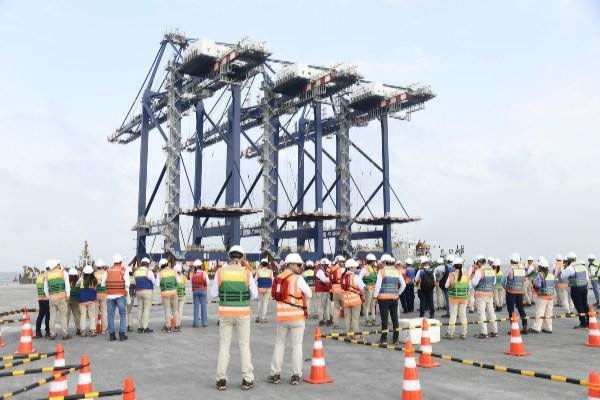
Upon arriving at the dock, the vessel was boarded by representatives from Colombian Immigration, the ICA (National Institute of Migration), the Turbo Health Department, and the Urabá and Darién Port Captaincy of DIMAR (Dimar), to conduct a "free discussion" that allowed for the unloading of the cranes to begin, which will take approximately four days.
Progress on the construction of the port
It's worth noting that with the arrival of this state-of-the-art equipment to Puerto Antioquia, the availability of the equipment necessary for its entry into operation will be complete.
This progress is in addition to the recent driving of more than 1,000 steel piles, which will support the viaduct and the maritime pier, with structures measuring up to 90 meters long and weighing 80 tons.
This process, which involved more than 44,000 tons of steel installed, was carried out by the Consorcio Terminal Marítimo – Cotema.
The addition of these cranes will strengthen the promise of making Puerto Antioquia a strategic hub for foreign trade, where its technological capacity and privileged location will contribute to reducing logistics times and costs, positively impacting the economic development of the region and the country.
Source: Valora Analitik 04-15-2025